Emergency Repair on Potomac Interceptor Reaches Halfway Mark — Upstream Section Reinforcement Complete
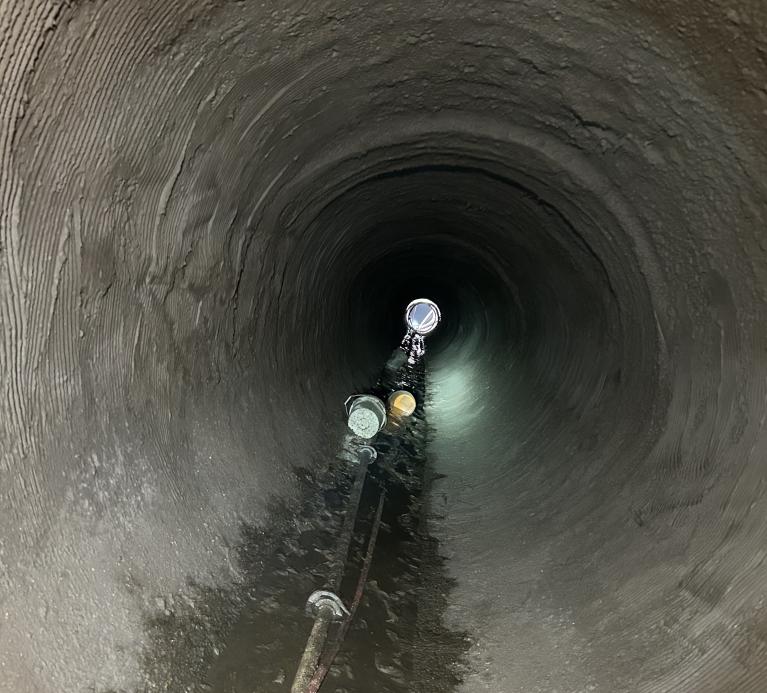
Reinforcement of the upstream section of the Potomac Interceptor has been completed, marking the halfway point in emergency repairs following the January 19 sewer line collapse. Crews continue to advance repairs on schedule, with full project completion expected by mid-March.
The upstream section of the damaged Potomac Interceptor was reinforced using geopolymer to restore its structural integrity. Crews lined approximately 320 linear feet of the pipe with geopolymer, which is as tough as concrete and is resistant to sewer gases. Teams are now preparing to apply the same advanced geopolymer technology to the downstream portion. This next phase will further secure the pipe and complete the emergency repair.
Once the downstream reinforcement is finished, a final CCTV inspection will be completed inside the pipe. Crews will then waterproof the existing containment around the exposed pipe sections, and DC Water will begin restoring flow to the Potomac Interceptor. This involves carefully removing the bulkhead gate that had been blocking the flow in the pipe, shutting down the bypass pumping system, and reintroducing wastewater service through the repaired pipe.
The remaining wastewater in the C & O Canal, which was temporarily used to divert flow, will drain into the Potomac Interceptor downstream and any residual wastewater will be pumped out of the canal. Work will then begin on the clean-up and rehabilitation of the canal and historic lock structures.
Environmental rehabilitation work continues in parallel with pipe repairs. The Phase 1 clean-up of Area 1, adjacent to the collapse site and the drainage channel, is now about 15% complete, including soil scraping, excavation, and installation of temporary erosion control matting. Crews are actively removing contaminated soil and vegetation, while coordination continues with the US Army Corps of Engineers, Environmental Protection Agency, National Park Service, and Maryland Department of the Environment to manage the remaining areas including the river channel and shoreline.
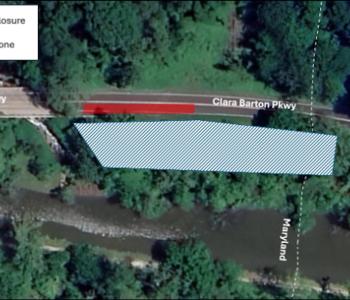
A section of the Potomac Interceptor, a 54-mile sanitary sewer system, collapsed January 19, along Clara Barton Parkway and C & O Canal National Historical Park near I-495. It’s now believed the large boulders and rocks used as backfill during initial construction in the 1960’s amplified the scale and magnitude of the event by blocking almost all the flow in the pipe when it failed.
This week, a comprehensive technical assessment examining the Potomac Interceptor’s condition and the events leading to the collapse, found no evidence of imminent structural failure. The review included reports over seven years, including multiple internal inspections. All data—video reviews, structural ratings, and engineering assessments—indicated that emergency action was not necessary prior to the incident.
DC Water remains committed to keeping the public, stakeholders, and partners informed as work progresses. Updates will continue to be shared as we move toward full repair and environmental recovery. DC Water is also giving residents and community members with an opportunity to provide feedback on the Environmental Rehabilitation Plan. You will find a link to contact us, as well as the latest information on our dedicated webpage for the Potomac Interceptor Repair.
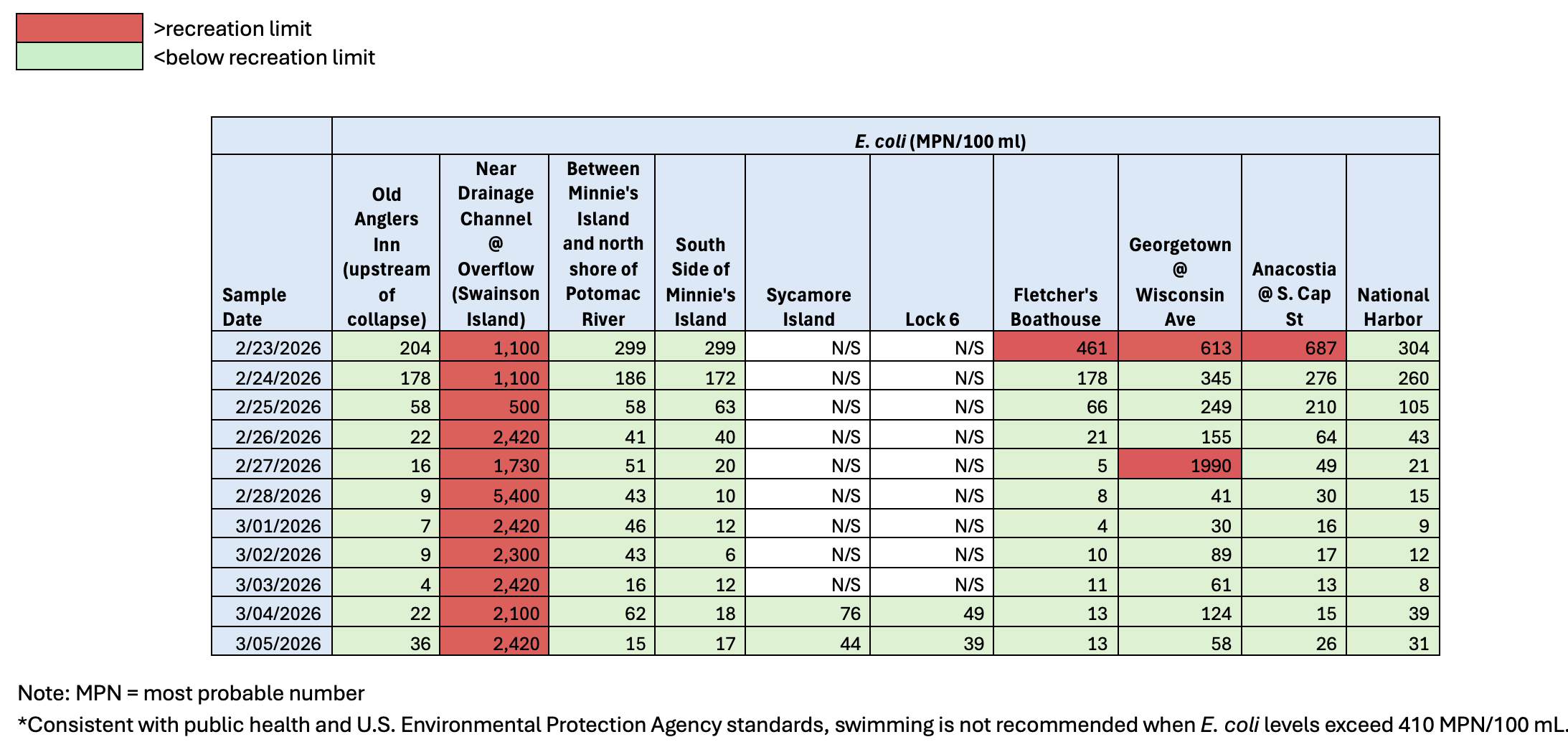
Water Quality Sampling Results
Fluctuations in water quality are influenced by factors such as weather events, river flow, runoff, pollutants, releases of combined overflows, and other sources discharging into waterways. Given these variables, measurements taken much further downstream cannot be attributed solely to this incident.
For the Potomac River, historical water quality data shows E. coli levels may vary from a range as low as 10 MPN/100mL to as much as 5,000 MPN/100mL on a given day. A more detailed explanation is posted on the District Department of Energy and Environment (DOEE) website at doee.dc.gov/release/potomac-interceptor-update-and-faqs.
As of March 4, two new sampling locations have been added at Sycamore Island and Lock 6. Sample results from February 23 - present. Past results may be found here.