History
The District of Columbia Water and Sewer Authority (DCWASA) was created by District law in 1996, with the approval of the United States Congress, as an independent authority of the District Government with a separate legal existence. In 2010 the Authority rebranded and became DC Water.
Service Area
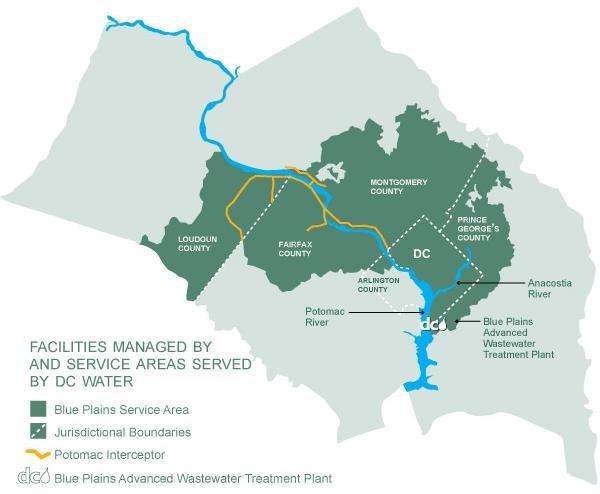
DC Water provides more than 700,000 residents and 27 million annual visitors in the District of Columbia with retail water and wastewater (sewer) service. With a total service area of approximately 725 square miles, DC Water also treats wastewater for approximately 1.8 million people in neighboring jurisdictions, including Montgomery and Prince George’s counties in Maryland and Fairfax and Loudoun counties in Virginia.
Pumped and Treated Water Storage
During Fiscal Year 2024, DC Water pumped an average of more than 100 million gallons of water per day. In addition, DC Water stores 60 million gallons of treated water at its eight facilities. The Washington Aqueduct stores an additional 49 million gallons.
Water Distribution System
DC Water delivers water through 1,300 miles of interconnected pipes, four pumping stations, four reservoirs, three water tanks, 43,860 valves, and 9,510 fire hydrants.
Sewer System
DC Water operates 1,900 miles of sanitary and combined sewers, nine wastewater pumping stations, 16 stormwater pumping stations, 12 inflatable dams and a combined sewer swirl facility.
Blue Plains
Blue Plains Advanced Wastewater Treatment Plant is located at the southernmost tip of the District, covering more than 150 acres along the Potomac River. Blue Plains is the largest advanced wastewater treatment facility in the world.
Wastewater Treatment Capacity
Blue Plains treats an annual average of 294 million gallons per day (MGD) and has a design capacity of 384 MGD, with a peak design capacity to treat more than 780 million gallons per day.