DC Water Begins Environmental Restoration to Areas Impacted by Sewer Overflow from the Potomac Interceptor
National Park Service Issues Special Use Permit to Move Forward with Restoration Plan
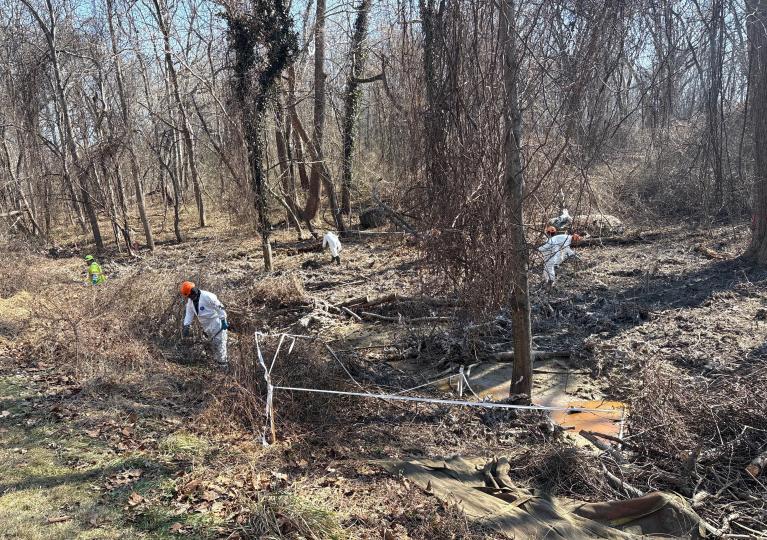
DC Water has begun the rehabilitation and environmental restoration to address areas affected by the sewer overflow from a section of the Potomac Interceptor that collapsed January 19. Contaminated material is being hauled away and work is underway to clear trees, brush, and contaminated debris in and around the collapse site as part of the environmental restoration plan approved by the National Park Service (NPS).
On February 28, NPS issued a Special Use Permit for the repair, rehabilitation, and environmental restoration of the Potomac Interceptor and the C&O Canal National Historical Park at the area of the Potomac Interceptor collapse between Locks 10 and 14.
DC Water continues to evaluate the environmental impacts of the overflow and is exploring further restoration efforts based on input from concerned residents and community groups, along with the ongoing collaboration with federal, state, and local regulators overseeing the environmental restoration.
In response to feedback, DC Water will be adding another water quality sampling location at Sycamore Island. Sampling is expected to begin at the new location this week. This is in addition to two locations on Minnie’s Island that were added last month and increases the number of sampling locations from the six original sites to nine.
The restoration plan sets out a roadmap for recovery, focusing on stabilizing the drainage channel, cleaning up debris, and rehabilitating wetlands, streams, and the canal within the C & O Canal National Historical Park.
The work will be carried out in two primary phases. The first phase focuses on immediate stabilization and remediation at the collapse site, including the removal of contaminated soil, debris, and vegetation, as well as the initial stabilization of affected drainage channels and areas along the Potomac River and impacted shoreline. This is expected to take one to two months to complete.
The second phase will address the broader environmental restoration and final stabilization, including the C&O Canal once the emergency repair is completed and the bypass pumping system is deactivated, which is anticipated to occur in mid-March. Work will be sequenced to minimize environmental disruption and protect public safety throughout the process.
Restoration activities are planned for three distinct areas: 1) the collapse site itself, where emergency repairs and soil remediation are ongoing; 2) the adjacent wetlands and stream corridors, which require rehabilitation to restore natural hydrology and habitat; and 3) the section of the C&O Canal impacted by the overflow, where sediment and debris will be removed, and native vegetation will be replanted. Each section will be addressed according to its specific needs, with progress carefully monitored and coordinated with NPS and Maryland Department of the Environment (MDE) to ensure environmental compliance and effective recovery.
The plan was developed with input and collaboration with NPS, the U.S. Army Corps of Engineers (USACE), MDE, Environmental Protection Agency (EPA), and District Department of Energy & Environment (DOEE).
Looking ahead, DC Water will continue to monitor progress and conduct post-restoration assessments to ensure the effectiveness of these efforts. As restoration activities advance, updates will be provided to keep the community informed and involved. Our goal is to return the parklands and waterways to their natural state, fostering a safe and vibrant environment for all.
The Environmental Restoration Plan and the NPS Special Use Permit are available for review on our dedicated page for the Potomac Interceptor Repairs. You will also find daily updates on the repair work, water quality sampling results, and additional information about the ongoing work and community outreach.
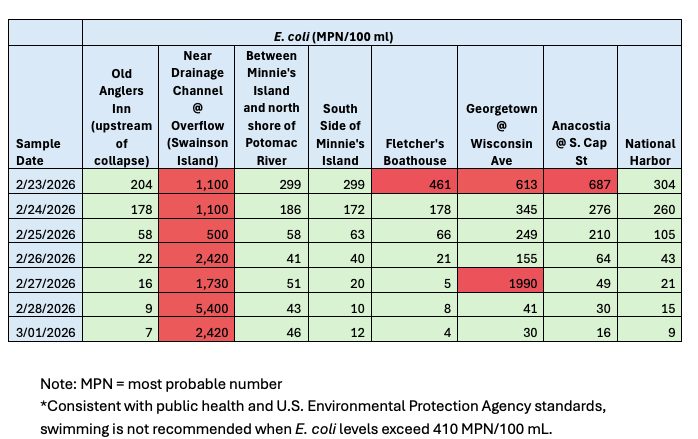
Water Quality Sampling Results
Fluctuations in water quality are influenced by factors such as weather events, river flow, runoff, pollutants, releases of combined overflows, and other sources discharging into waterways. Given these variables, measurements taken much further downstream cannot be attributed solely to this incident.
For the Potomac River, historical water quality data shows E. coli levels may vary from a range as low as 10 MPN/100mL to as much as 5,000 MPN/100mL on a given day. A more detailed explanation is posted on the District Department of Energy and Environment (DOEE) website at doee.dc.gov/release/potomac-interceptor-update-and-faqs.
Sample results from February 23 - present. Past results may be found here.