WASA Proposes Rate Increase for Water and Sewer Services

July 03, 2008

The District of Columbia Water and Sewer Authority (WASA) Board is considering a proposed 8.5 percent rate increase for water and sewer services, effective October 1, 2008. WASA provides water and wastewater collection and treatment services for retail customers in the District. Gradual rate increases are required to cover the costs of WASA’s 10-year, $3.1 billion capital improvement program to upgrade the District’s water and sewer infrastructure and to meet expanding federal requirements for controlling water pollution.

If approved, the combined water and sewer rate would increase from $5.37 per hundred cubic feet (Ccf) to $5.83 per Ccf. In addition to this increase, the Right-of-Way/Payment In Lieu Of Taxes (PILOT) fee will increase from $0.47 per Ccf to $0.52 per Ccf, divided as follows: Payment in Lieu of Taxes to the District of Columbia - $0.39 per Ccf; and District of Columbia Right-of-Way fee - $0.13 per Ccf. These fees are charged to WASA by the District of Columbia government, and are passed through as a separate line item on the WASA bill. Under the current proposal, the typical residential customer’s monthly bill would increase by approximately $4.24 per month (based on an average monthly usage of 8.33 (Ccf) or 6,231 gallons of water).

The proposed rate increases will be extensively publicized and discussed at a number of community meetings and a formal hearing. Included in this year’s public discussion on rate adjustments will be WASA’s proposed policy to implement a separate impervious surface rate structure. Rather than use the per-gallon water purchase rate, to pay for the $2.2 billion combined sewer overflow (CSO) control plan, this separate proposal for a new rate structure, effective with the April 2009 bill, would be based on the amount of impervious area on each property producing water runoff entering the city’s sewer system.

Additional information on WASA’s rate proposal is available by calling the Office of Public Affairs at (202) 787-2200.

Latest News

Photo of inside Potomac Interceptor at Dulles showing newly lined tunnel

First of four emergency repairs on Potomac Interceptor finished

DC Water has finished the first of four emergency repair projects on the Potomac Interceptor sewer line. Crews completed work today to strengthen a 600-foot section of pipe at Dulles International Airport.

Picture of repaired segment before the geopolymer work and after the work is done

Crews also reach a major milestone near Dulles International Airport as the next phase of repairs begins this week

DC Water has completed the first major step in emergency repairs to a 175-foot section of the Potomac Interceptor near Pennyfield Lock in Potomac, Maryland. Crews added a new, stronger lining inside the pipe after inspections found serious wear and damage. The work is part of ongoing repairs to 1,700 linear feet of pipe near Pennyfield Lock. Work began on Friday to apply geopolymer, a concrete-like material, inside the pipe. With the new lining complete, crews are preparing for the next phase of work for the remainder of the pipe segment.

image of clara barton parkway with lane closure marked in red

Beginning this week and continuing through mid-August, DC Water will temporarily close one lane overnight on Clara Barton Parkway at the Maryland-D.C. border. The closures are needed so crews can ...

Upcoming Meeting

Board of Directors Meeting

April 24, 2023

Monday 9:00 AM

Announcement

DC Water Officials with NPS and ANC commissioners doing ceremonial groundbreaking
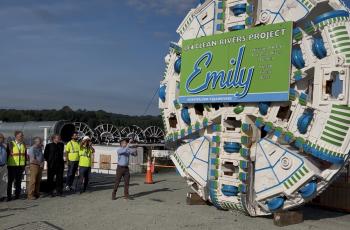
DC Water Breaks Ground on Piney Branch Tunnel, Final Phase of DC Clean Rivers Project

Today, DC Water broke ground on the Piney Branch Tunnel, the final major tunnel in our Clean Rivers Project. This work will help keep sewage and trash out of local waterways and make Rock Creek, the Potomac River, and the Chesapeake Bay cleaner for our community.

When we finish the Piney Branch Tunnel, it will hold at least 4.2 million gallons of rainwater and wastewater during heavy storms. Instead of overflowing into Piney Branch, that water will go to the Blue Plains Water Resource Recovery Facility, where it will be treated.

Latest Blog Post
Plastic bottles, cups and other floating debris on the surface of the Anacostia River before the Anacostia River Tunnel began operating.
Cleaner Waterways Start With Everyday Choices
Protecting our waterways starts with everyday actions and continues through critical infrastructure designed to keep pollution out of our rivers.
Upcoming Meeting

Customer Service Center Announcement

Payment Plan Incentive: provides a credit back of 50% of the last 3 payments made. Eligible participants are residential customers who have had an outstanding balance for 60 days or greater and with an outstanding balance of $500 or more.