Soil Removal Underway on Section of C & O Canal
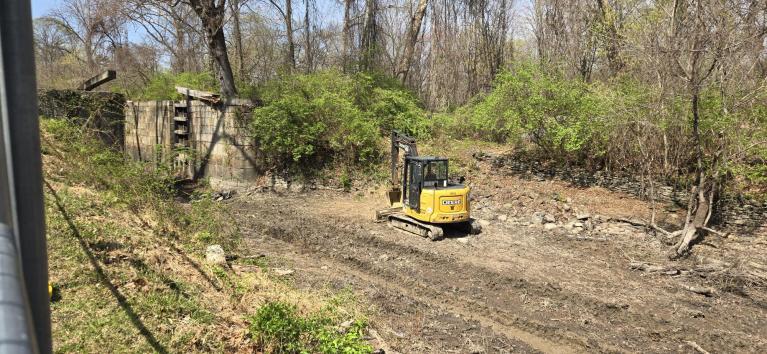
- Today, DC Water and its contractors began removing contaminated soil between locks 13 and 14 in the C & O Canal, which was used as a temporary bypass during the Potomac Interceptor repair effort.
- Crews will remove the soil down to the clay liner and reconstruct the canal to National Park Service specifications.
- Clean-up efforts continue at Lock 10, with sludge removal now underway between locks 11 and 13.
- Beautification and revegetation efforts are pending evaluation of soil sampling in the areas directly impacted by the overflow, including the drainage channel, Culvert 12 (Rock Run Culvert), and the tributary to the Potomac River.
- Demobilization of the pumping site continues, and work is underway to prepare the site for the previously planned long-term rehabilitation of 2700 linear feet of the Potomac Interceptor that has been accelerated in this area.
- Crews have begun clearing brush and trees to begin excavation on a section of the pipeline outside the I-495 Beltway, where a trench box is being installed with supportive excavation. The site will be used for slip lining, a process where new pipe sections are inserted into the existing pipe to rehabilitate it to like-new condition.
- This is one of three locations that will be used for slip lining, including the open pipe sections where the collapse occurred and the opening for the bypass pumps. Each site provides a long, straight section necessary to slip line.
- Ground penetrating radar is being used to look for rocks and boulders in the area that could pose additional risk, like the blockage that occurred during the collapse.
- An aerial assessment of the 54-mile Potomac Interceptor is underway and will continue through the end of the week. Drones equipped with LiDAR scanning are being used to map current site conditions along the Potomac Interceptor alignment.
- The data will provide a better understanding of the changing landscape and development as part of strategic planning for DC Water’s ongoing 10-year, $625 million rehabilitation of the interceptor.
Water Quality Sampling Results
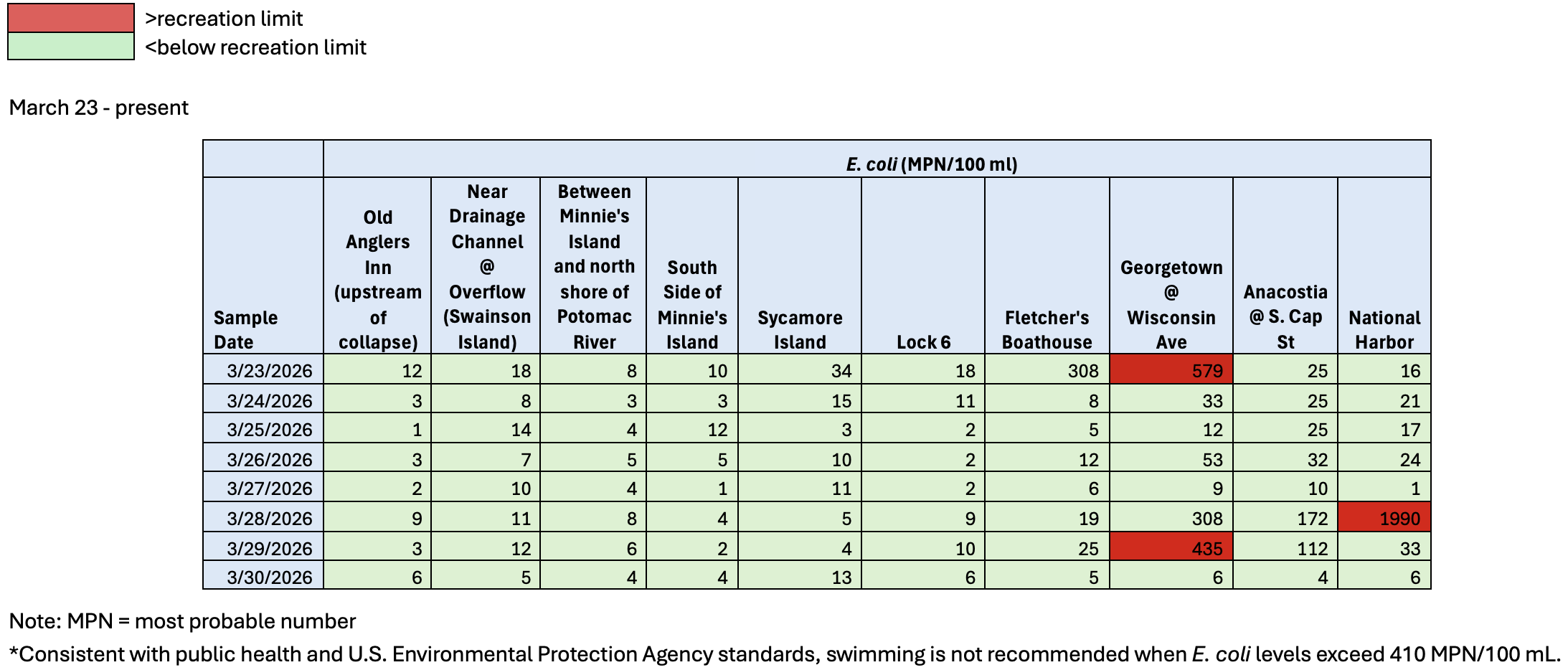
It's important to understand that rain, snow, heat, contaminated runoff, and natural sources of E. coli such as wildlife can cause higher bacteria levels in urban rivers such as the Potomac River.
As there have been no overflows to the river from the Potomac Interceptor for more than a month prior to completion of emergency repairs, recent fluctuations in measurements are more likely due to these other known factors.
For the Potomac River, historical water quality data shows E. coli levels may vary from a range as low as 10 MPN/100mL to as much as 5,000 MPN/100mL on a given day. A more detailed explanation is posted on the District Department of Energy and Environment (DOEE) website at doee.dc.gov/release/potomac-interceptor-update-and-faqs.
Sample results from March 23 - present. Past results may be found here.
For the latest updates and information, including how to provide feedback on the environmental rehabilitation, go to our dedicated Potomac Interceptor Response page.