DC Water Response to Federal and State Lawsuits regarding the Potomac Interceptor Sewer Overflow
DC Water issues the following statement in response to the complaints filed by the Maryland Office of the Attorney General and the Department of Justice on behalf of the U.S. Environmental Protection Agency regarding the Potomac Interceptor sewer overflow into the Potomac River that occurred on January 19, 2026:
DC Water is fully committed to the long-term rehabilitation of the Potomac Interceptor. Although the lawsuits are still under review, they underscore our commitment to advance the planned repairs for the entire 54-mile pipeline, including the impacted segment. Executing this work on federal land requires close collaboration with the lead regulatory agency, which in this case is the National Park Service (NPS). Since 2018, DC Water has worked with NPS on site assessments, environmental reviews, and emergency repairs on portions of the pipeline to ensure environmental protection and public safety. DC Water will renew its requests for streamlined environmental reviews to allow rehabilitation of the interceptor to move forward more quickly. DC Water previously requested a categorical exclusion for this section of the pipe previously, but it was not approved. DC Water will continue to engage all stakeholders and work with the Maryland Department of the Environment on the environmental rehabilitation as we work to protect the Potomac River and serve the community.
From the outset, DC Water’s highest priority was to safely and quickly contain the overflow and repair the damaged section of the Potomac Interceptor. Crews implemented an emergency bypass system that successfully managed the majority of the overflow within five days and fully stopped all discharges to the Potomac River within 21 days. The repairs of the affected segment were completed in 55 days.
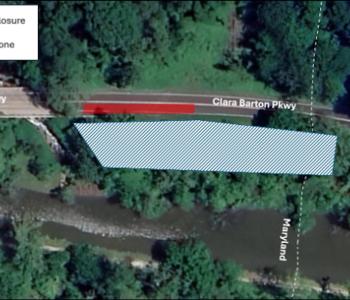
DC Water is working now to accelerate the rehabilitation of more than 2,700 linear feet of pipeline in this area that was previously scheduled for improvement. Initial environmental remediation efforts are also nearly complete, with ongoing water quality testing showing that downstream conditions have returned to normal and have remained stable for several months. In addition, recent testing results continue to indicate low bacteria levels near the site of the break.