DC Water part of Water Research Foundation Team Awarded $1 million Grant by EPA for Exciting New Wastewater Innovation

October 19, 2020

DC Water announced today that it is partnering with Water Research Foundation, Hampton Roads Sanitation District and several universities on groundbreaking new research that will save customers money and could improve water quality.

The goal is improved wastewater treatment and DC Water’s concept for improving the technology has the potential to save millions for cities around the world, said Chief Executive Officer and General Manager David L. Gadis.

“Our goal is to reduce energy and chemical use and save our customers money while using innovative technology to improve the environment,” explained Mr. Gadis, while praising the partnership with Water Research Foundation, Hampton Roads Sanitation District, George Washington University, Northwestern University and Columbia University.

The U.S. Environmental Protection Agency awarded the collaboration team its ‘Science to Achieve Results grant’ with a three-year timeframe for achieving results. At DC Water, the project is led by Haydee De Clippeleir, the research program manager and Christine deBarbadillo, the director of clean water quality and technology.

deBarbadillo said the Authority has worked closely with all members of this collaboration team for many years exploring solutions and upgrades to existing wastewater treatment processes. Removing nitrogen is a critical element in DC Water’s requirement to clean wastewater to the highest possible level before discharging it back into the Potomac River, where it leads to the Bay.

Discharge of excess nitrogen and phosphorus can lead to algal blooms in surface waters. When that happens, the health of marine life, from fish to crabs to dolphins, is jeopardized.

The typical treatment methods used at water resource recovery facilities to eliminate nitrogen rely on addition of readily degradable organic chemicals such as methanol as well as consuming a tremendous amount of electricity.

“We are using a different pathway into the nitrogen cycle to more efficiently remove nitrogen from wastewater and reduce energy and chemical costs,” deBarbadillo said.

Latest News

Photo of inside Potomac Interceptor at Dulles showing newly lined tunnel

First of four emergency repairs on Potomac Interceptor finished

DC Water has finished the first of four emergency repair projects on the Potomac Interceptor sewer line. Crews completed work today to strengthen a 600-foot section of pipe at Dulles International Airport.

Picture of repaired segment before the geopolymer work and after the work is done

Crews also reach a major milestone near Dulles International Airport as the next phase of repairs begins this week

DC Water has completed the first major step in emergency repairs to a 175-foot section of the Potomac Interceptor near Pennyfield Lock in Potomac, Maryland. Crews added a new, stronger lining inside the pipe after inspections found serious wear and damage. The work is part of ongoing repairs to 1,700 linear feet of pipe near Pennyfield Lock. Work began on Friday to apply geopolymer, a concrete-like material, inside the pipe. With the new lining complete, crews are preparing for the next phase of work for the remainder of the pipe segment.

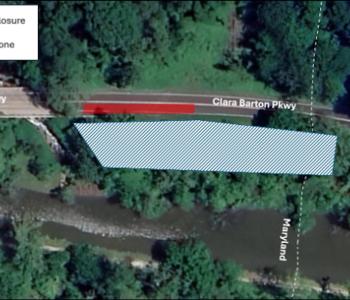
image of clara barton parkway with lane closure marked in red

Beginning this week and continuing through mid-August, DC Water will temporarily close one lane overnight on Clara Barton Parkway at the Maryland-D.C. border. The closures are needed so crews can ...

Upcoming Meeting

Board of Directors Meeting

April 24, 2023

Monday 9:00 AM

Announcement

DC Water Officials with NPS and ANC commissioners doing ceremonial groundbreaking
DC Water Breaks Ground on Piney Branch Tunnel, Final Phase of DC Clean Rivers Project

Today, DC Water broke ground on the Piney Branch Tunnel, the final major tunnel in our Clean Rivers Project. This work will help keep sewage and trash out of local waterways and make Rock Creek, the Potomac River, and the Chesapeake Bay cleaner for our community.

When we finish the Piney Branch Tunnel, it will hold at least 4.2 million gallons of rainwater and wastewater during heavy storms. Instead of overflowing into Piney Branch, that water will go to the Blue Plains Water Resource Recovery Facility, where it will be treated.

Latest Blog Post
Plastic bottles, cups and other floating debris on the surface of the Anacostia River before the Anacostia River Tunnel began operating.
Cleaner Waterways Start With Everyday Choices
Protecting our waterways starts with everyday actions and continues through critical infrastructure designed to keep pollution out of our rivers.
Upcoming Meeting

Customer Service Center Announcement

Payment Plan Incentive: provides a credit back of 50% of the last 3 payments made. Eligible participants are residential customers who have had an outstanding balance for 60 days or greater and with an outstanding balance of $500 or more.