DC Water Christens Giant Tunnel Boring Machine
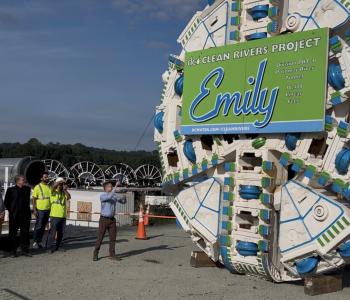
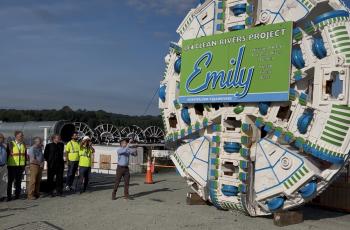
WASHINGTON, DC Today, the District of Columbia Water and Sewer Authority (DC Water) named its massive tunnel boring machine (TBM), christened it with DC tap water, and prepared to send it underground to tunnel more than four miles along the Potomac at a depth of approximately 100 feet. The machine is more than 400 feet long and weighs more than 1300 tons. It will dig the Blue Plains Tunnel, which is a portion of DC Waters Clean River Project to significantly reduce combined sewer overflows (CSOs) and improve water quality in the District of Columbia.
District of Columbia Mayor Vincent C. Gray, EPA Regional Administrator Shawn Garvin, DC Councilmember Mary Cheh, DC Water Board of Directors Chairman Allen Lew and DC Water General Manager George S. Hawkins participated in todays event at the Blue Plains Advanced Waste Water Treatment Plant.
"Much like her namesake, Lady Bird will be performing important work for the long-term health of our rivers," said Mr. Hawkins. "This tunnel will connect to another along the Anacostia River and another under Northeast DC that will reduce combined sewer overflows into the Anacostia by 98 percent."
As in many older cities, about one-third of the District has a combined sewer system. CSOs occur during heavy rain when the mixture of sewage and stormwater cannot be contained in the sewer pipes and overflows to the nearest water body. CSOs contain bacteria and trash that are harmful to the environment. When the system was designed the alternative was combined sewage backing up in homes and businesses and on the streets. Modern engineering avoids this problem with separate pipes for sewage and stormwater. Since the early 1900s, only separate sewer systems have been installed in the District.
DC Waters plan to significantly reduce CSOs to the Anacostia River is to build massive underground tunnels that will store the combined sewage and runoff during intense rainstorms and then slowly release it when the system has the capacity to treat it. Similar CSO tunnels exist in other large cities like Chicago, Indianapolis, and Atlanta.
"Earlier this year, I unveiled the Sustainable DC Plan, a 20-year plan to make the District the healthiest, greenest, most livable city in the nation," Mayor Gray said at todays event. "The Clean Rivers Project goes a long way to providing sustainability for the region, making our waterways healthier and cleaner, while also addressing localized sewer issues from a century of urban development."
DC Water Board Chairman and City Administrator Allen Lew added, "This project is a massive undertaking, but it will pay huge benefits as well. Todays celebration marks the beginning of an ambitious effort to improve the health of the Anacostia River while also reducing the likelihood of flooding and sewer backups during intense storms in the Bloomingdale and LeDroit Park neighborhoods."
TBMs are named much like boats in the nautical world. DC Waters TBM was named "Lady Bird" after Claudia Alta "Lady Bird" Johnson, First Lady and wife of President Lyndon B. Johnson. When her husband became president in 1964 she made it her mission to preserve and protect the environment. In 1964 she formed The Committee for a More Beautiful Capital, whose positive contributions are still visible today. She encouraged her husband to declare the Potomac River "a national disgrace," which drew attention to the declining health of Americas waterways and was a catalyst for the eventual Clean Water Act of 1972.
Starting from two deep shafts at Blue Plains, the Lady Bird TBM will tunnel 24,200 linear feet up the Potomac River and to the Anacostia River, creating a metro-sized tunnel. That tunnel will also be instrumental in DC Waters effort to reduce nutrient pollution to the Potomac River and Chesapeake Bay, and the innovative design saved $600 million over the alternatives.
Additional tunnels are also planned to reduce CSOs in the Potomac and Rock Creek sewersheds, although DC Water is also developing a green infrastructure pilot program.
"The pilot will measure the feasibility of using green techniques such as green roofs, raingardens, tree and grass plantings, porous pavement, and rain barrels to capture and infiltrate stormwater before it can enter the storm or sewer system," said Mr. Hawkins. "These may serve to reduce combined sewer overflows to the Potomac River and Rock Creek while greening the city on a scale never before seen."
For more information, and specifications on the TBM and its route, please visit http://www.dcwater.com/news/presskits/tunnel.cfm or follow "Lady Bird" on Twitter @LadyBirdTBM.