Lady Bird Emerges!
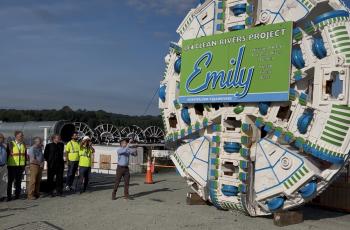
DC Waters celebrated tunnel boring machine (TBM), Lady Bird, has completed her mission, creating a four-and-a-half-mile-long tunnel that will be used to help improve the water quality in the Anacostia River. Lady Bird completed her dig earlier this month and today her cutterhead was extracted from a 100-foot-deep shaft near DC Waters Main Pumping Station in Southeast Washington, DC.
Lady Bird began her journey two years ago, in July 2013, from a starting point at the Blue Plains Advanced Wastewater Treatment Plant. She tunneled along the Potomac River northward to Poplar Point and then crossed under the Anacostia River and continued west, finishing at a deep shaft along Tingey Street, SE. To prepare for her arrival, this shaft was filled with flowable fill concrete and water, to protect against changes in pressure as Lady Bird mined through the shaft wall. Crews then dug out the concrete to reveal the muck-brown machine the bright blue, green and white paint she wore into the tunnel long since burnished away. A special heavy-duty crane was deployed to hoist the cutterhead the elaborate steel face of the machine with built-in cutting and slicing toolsand the other pieces of the TBM that were too heavy for the cranes on site.
This is a terrific milestone for DC Waters Clean Rivers Project, said DC Water CEO and General Manager George S. Hawkins. We are fortunate that the tunneling went so smoothly, finishing on time and on budget, and I applaud our DC Water staff as well as Traylor Skanska Jay Dee and everyone else who took part in this successful dig.
DC Waters Clean Rivers Project will incorporate two methods to keep combined sewage and stormwater from overflowing into waterways, during heavy rains in the parts of the city with a combined sewer system. The first is to build underground tunnels that will hold combined sewage and stormwater until rain subsides, then convey it for treatment at Blue Plains. The second is to create green infrastructure to capture and infiltrate rain on-site before it can reach the combined sewer system.
Carlton Ray, Director of the DC Clean Rivers Project, added Lady Bird performed as well as projectedhaving a one-day best mark of 150 feet. In her best week, she tunneled 631 feet. This TBMs success means we are one step closer to a cleaner Anacostia River.
Lady Bird dug the southernmost segment of the Anacostia River Tunnel. The next section will be mined by another TBM named Nannie, who is preparing to begin her tunnel at a site near RFK Stadium. The Northeast Boundary Tunnel is the longest portion of tunnel, and that contract has yet to be awarded. At the northern tip of the tunnel system is the First Street Tunnel, a relatively short tunnel that will be mined by Lucy, and is designed as a flood protection project for the Bloomingdale and LeDroit Park neighborhoods.
Lady Bird removed approximately 1.2 million tons of material that she mined. This was hauled away in nearly 72,000 truckloads over the last two years. She built the tunnel with 28,189 pre-cast concrete segments which made up 4,027 full rings.
The cost of tunnel boring machines is included in the contract for each tunnel segment; therefore, the TBMs are owned by the contractors for each tunnel portion. Lady Bird is the property of the contractor and can be extracted and used on another project. Lady Bird is being sold back to her German manufacturer, Herrenknecht.
For more information about the Clean Rivers Project please visit: dcwater.com/cleanrivers
More information about Lady Bird can be found at: dcwater.com/ladybird
Videos of Lady Bird and the Clean Rivers Project can be viewed at:
https://www.youtube.com/watch?v=J5oEqtpB1go
https://www.youtube.com/watch?v=se5YebfWfkw