DC WASA Board Revises Lead Service Line Removal Program

September 04, 2008

The District of Columbia Water and Sewer Authority Board of Directors today approved a significant modification of the Lead Service Replacement (LSR) Policy to encourage full service line replacements and to manage costs. (The service line is the pipe that carries water from the main in the street to the home.) Under the newly structured LSR program,

-- Lead lines in public space (between the main and the property line) will continue to be replaced with copper pipe in conjunction with DC WASA’s ongoing water main replacement projects.

-- In coordination with the District Department of Transportation street paving schedule, DC WASA will replace the public portion of a lead line only when the customer agrees to have the private side replaced or if that side is already non-lead.

-- Where a customer is replacing the private portion of a lead service line, at the customer’s request, DC WASA will replace the public side of the lead line with funds budgeted for this purpose.

Before today’s action, Board policy mandated the replacement of all of the approximate 35,000 known public lead service lines in the District of Columbia by 2016 at an estimated cost of $400 million. This accelerated program began in 2004 when elevated lead levels were found in tap water samples at some District homes. However, for the last three and a half years, following a change in water chemistry, District drinking water has met federal limits for lead and is in full compliance with all U.S. Safe Drinking Water Act regulations.

“In a cost-benefit and impact analysis of the LSR program we have consulted experts from the Centers for Disease Control, U.S. Environmental Protection Agency, George Washington University Center for Public Health, as well as local health officials and the public,” said General Manager Jerry N. Johnson. “We are providing clean and safe drinking water, and it’s time we re-evaluated the pace of the program given several years of experience and other water and sewer infrastructure needs throughout the District.”

Latest News

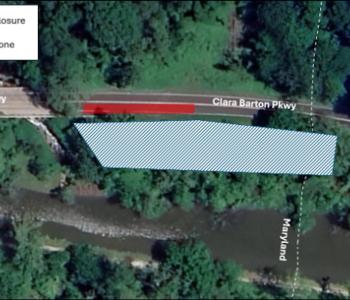
image of clara barton parkway with lane closure marked in red

Beginning this week and continuing through mid-August, DC Water will temporarily close one lane overnight on Clara Barton Parkway at the Maryland-D.C. border. The closures are needed so crews can ...

Pennyfield Lock Potomac Interceptor bypass pipeline running next to C & O Canal with equipment

There is no active spill or overflow. Work to strengthen the pipe to begin soon.

Today, DC Water completed construction on a temporary bypass system as part of sewer repairs on the Potomac Interceptor near Pennyfield Lock in Potomac, Maryland. Crews turned on the pumps and successfully tested the system. With the bypass now ready, it will allow us to begin the emergency repairs inside the pipe by carrying the wastewater around the repair area.

DC Water Officials with NPS and ANC commissioners doing ceremonial groundbreaking

Today, DC Water broke ground on the Piney Branch Tunnel, the final major tunnel in our Clean Rivers Project. This work will help keep sewage and trash out of local waterways and make Rock Creek, the Potomac River, and the Chesapeake Bay cleaner for our community.

When we finish the Piney Branch Tunnel, it will hold at least 4.2 million gallons of rainwater and wastewater during heavy storms. Instead of overflowing into Piney Branch, that water will go to the Blue Plains Water Resource Recovery Facility, where it will be treated.

Upcoming Meeting

Board of Directors Meeting

April 24, 2023

Monday 9:00 AM

Announcement

DC Water Officials with NPS and ANC commissioners doing ceremonial groundbreaking
DC Water Breaks Ground on Piney Branch Tunnel, Final Phase of DC Clean Rivers Project

Today, DC Water broke ground on the Piney Branch Tunnel, the final major tunnel in our Clean Rivers Project. This work will help keep sewage and trash out of local waterways and make Rock Creek, the Potomac River, and the Chesapeake Bay cleaner for our community.

When we finish the Piney Branch Tunnel, it will hold at least 4.2 million gallons of rainwater and wastewater during heavy storms. Instead of overflowing into Piney Branch, that water will go to the Blue Plains Water Resource Recovery Facility, where it will be treated.

Latest Blog Post
Five photos from the American Water Works Association (AWWA) ACE26 conference featuring panel discussions, technical presentations, networking, and attendees posing at the ACE26 display.
ACE26 Highlights: How DC Water Advanced the Conversation on Water
More than 80 DC Water employees joined thousands of water professionals in Washington, D.C., sharing expertise, building partnerships and advancing conversations that will help shape the future of water.
Upcoming Meeting
Date
July 23, 2026
Thursday, 9:30 AM

Upcoming Events

Jul 25

Customer Service Center Announcement

Payment Plan Incentive: provides a credit back of 50% of the last 3 payments made. Eligible participants are residential customers who have had an outstanding balance for 60 days or greater and with an outstanding balance of $500 or more.