District Breaks Ground on Large-Scale Flood Relief for Bloomingdale and LeDroit Park
(WASHINGTON, D.C.) -- To mitigate flooding and sewer backups in the Bloomingdale and LeDroit Park neighborhoods, Mayor Vincent C. Gray and DC Water today announced a major new infrastructure project at the site of the former McMillan Sand Filtration Plant. The Northeast Boundary Neighborhood Protection Project is a product of the Mayors Task Force on the Prevention of Flooding, and will be built in three phases between now and 2022.
Mayor Gray established the task force in late August and named City Administrator Allen Y. Lew and DC Water General Manager George S. Hawkins as co-chairs.
"I asked the Task Force two basic questions," said Mayor Gray. "The first is why the long-term solution to this historic problem was still more than a decade away. The second is whether anything more could be done in the interim. This project answers both questions. I applaud the Task Force and DC Water for developing it, and I want the residents of the affected communities to know that relief is on the way. It will be meaningful, and it will come soon."
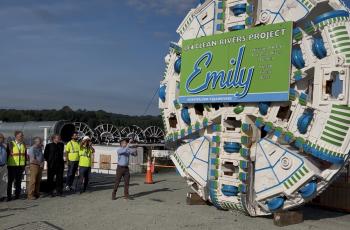
The two neighborhoods are connected to an undersized sewer system and have been subject to flooding during heavy rains for more than a century. DC Waters long-term approach to this problem, the Clean Rivers Project, is a tunnel system that will add capacity to the sewers and was originally scheduled for completion in 2025. Mayor Gray convened the Task Force and DC Water began a new investigation of causes and possible mitigation strategies after four intense storms inflicted property damage in Bloomingdale and LeDroit Park this summer.
The first phase will store a total of up to 6 million gallons of stormwater, using two existing underground basins at the McMillan site. Flow will be diverted from feeder sewers adjacent to the McMillan site, capturing stormwater before it arrives in Bloomingdale and LeDroit Park and reaches the sewer system. This will help reduce the excessive pressure that currently causes sewer backups and overland flooding during heavy rain storms.
Preparation for construction on the first phase will begin immediately, with completion projected in spring 2014. This construction will not disrupt the Districts proposed development plans for the McMillan site.
"Our engineers have literally gone back to the drawing board more than a dozen times, and the McMillan project is the result," said Hawkins. "The team has been hard at work this summer and fall, investigating and evaluating every possible approach to this problem. Weve heard the message loud and clear that waiting the better part of a decade for the Clean Rivers Project isnt an option. We appreciate the publics patience, and were ready to deliver."
The second phase of the project will bring the construction of a 19-foot-diameter tunnel under 1st Street NW. DC Water will construct the tunnel to hold an additional 6 million gallons of wastewater and stormwater during heavy rain events, using a temporary pumping station to carry flow into the Northeast Boundary sewer after the storm passes. Completion for the second phase is projected for spring 2016.
The third phase of the project is a realignment and acceleration of the Northeast Boundary portion of the Clean Rivers Project. The new alignment will create less disruption and involve less private property during construction than the prior plan. When this section of tunnel is complete, scheduled in 2022, DC Water will convey the flow from the 1st Street tunnel to the Blue Plains Advanced Wastewater Treatment Plant.
"This project is colossal in size, scope and neighborhood impact and its going to require significant coordination among the agencies and ongoing communication with the community to make it work," said Lew. "Were going to treat it like the building of a stadium or a convention center and bring together everyone we need, as often as needed, to get the job done. This project is critical because it not only helps mitigate the flooding problem, but provides much-needed additional capacity for future economic development opportunities in the area."
The Northeast Boundary Neighborhood Protection Project at the McMillan site is the latest and largest step in a series of actions by District Government and DC Water in response to the four flooding and sewer backup events in Bloomingdale and LeDroit Park last summer.
On November 1st the District Department of Transportation (DDOT) installed new catch basins (or storm drains) on the 500 and 600 blocks of Florida Avenue NW to assist with removing water from the roadway during rain events. Work was completed in late November, and a similar effort will commence in early January that will also include installation of porous pavers, tree boxes and other water-capturing features in the sidewalk along the 100 block of Rhode Island Avenue NW. Work on this project will be completed in mid-March.
The other steps have included:
- A thorough visual inspection of sewers in Bloomingdale, LeDroit Park and parts of Shaw and Columbia Heights;
- A rebate program for installing backflow preventers (backwater valves);
- Individual engineering consultations;
- A rain barrel-subsidy and installation program;
- Sandbag distribution; and
- Analysis of potential changes in plumbing and housing code.
The cost of the Northeast Boundary section of the Clean Rivers Project is estimated at $600 million, with funding from DC Water ratepayers. Accelerating the solution, adding the stormwater capture and the 1st Street tunnel will add approximately $40 million to the cost.
The Mayors Task Force on the Prevention of Flooding will deliver its final report to Mayor Gray by December 31. For more information on the task force, go to www.oca.dc.gov.