DC Water delivers a cleaner Anacostia River by opening first leg of massive tunnel system
- New tunnel segment reduces combined sewer overflows to Anacostia by more than 80 percent, holds 100 million gallons of combined sewage
- $1.6 billion investment of total $2.7 billion program for healthier District waterways
Today, the District of Columbia Water and Sewer Authority (DC Water) commissioned its 7-mile-long tunnel segment that will substantially reduce combined sewer overflows to the Anacostia River, dramatically improving the river’s health. The tunnel system will capture and hold up to 100 million gallons of combined sewage in heavy rainfalls and deliver it to the Blue Plains Advanced Wastewater Treatment Plant for treatment. Today’s commissioning is ahead of the deadline outlined in a 2005 consent decree with the US Environmental Protection Agency, US Department of Justice and the District of Columbia.
DC Water Board Chairman and Director of the Department of Energy and Environment Tommy Wells said, “It has been my job, as well as my passion, to improve and protect the Anacostia River. I crafted The Anacostia River Clean Up and Protection Act of 2009 to do just that. While at DOEE and as DC Water Board Chair, I have had the pleasure to watch the progress of the DC Clean Rivers Project. This project brings immense improvements to the District in terms of healthier waterways which will lead to a more vibrant waterfront and opportunities for recreation on the Anacostia.”
DC Water Interim CEO and General Manager Henderson J. Brown, IV added, “I want to thank everyone who has contributed to this milestone, from our engineers to our elected officials to our ratepayers. The significant protective measures we put in place today, and those still to come, would not be possible without the commitment of this entire community.”
The celebration also included remarks by Dave Ross, Assistant Administrator for the Office of Water at the U.S. Environmental Protection Agency, U.S. National Park Service Superintendent Tara Morrison, Director of the Clean Rivers Program Carlton Ray and Former Executive Director of Groundwork Anacostia River DC, Dennis Chestnut.
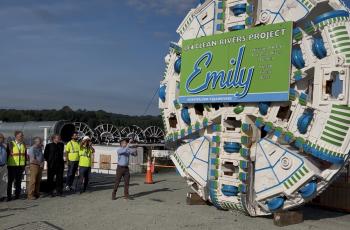
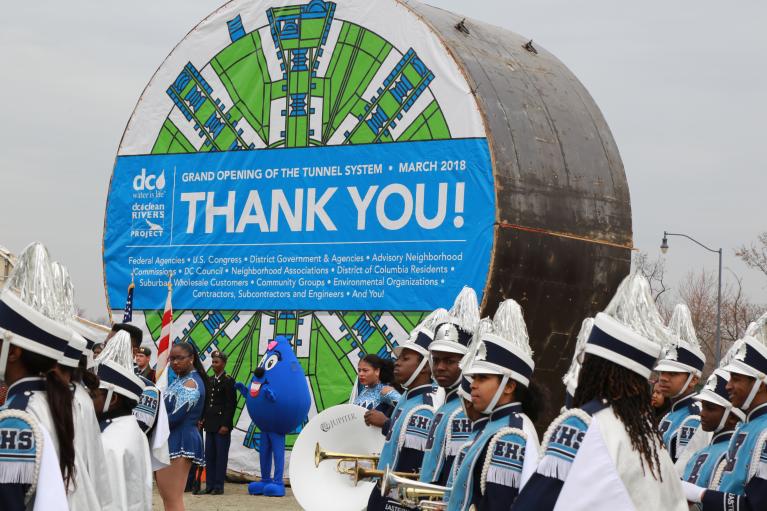
Hundreds flocked to the event that included bluegrass music, marching bands, festivities and a model tunnel boring machine that demonstrates how the tunnel segments are mined.
To illustrate the grand size of the Anacostia River Tunnel System, three bulk head gates were displayed on the ground and a fourth gate was removed by a large-scale crane. Removing these gates opens the tunnel, to prevent 80 percent of sewage overflows to the Anacostia River.
The construction of this tunnel began in 2013 and has a 23-foot inside diameter. Combined with the new 225 million-gallon-per-day Wet Weather Treatment Facility at Blue Plains, this tunnel portion will reduce combined sewer overflows by more than 80 percent. Mining for the next tunnel segment, the Northeast Boundary Tunnel, will soon be underway and is scheduled for completion in 2023. The complete tunnel system will capture 98 percent of sewage overflows to the Anacostia. It will also provide more flooding relief for residents in the Bloomingdale and LeDroit Park neighborhoods who for decades were served by an undersized sewer.
As in many older cities, about one-third of the District has a combined sewer system. A combined sewer overflow (or CSO) occurs during heavy rain when the mixture of sewage and stormwater cannot fit in the sewer pipes and overflows to the nearest water body. CSOs contain bacteria and trash that can be harmful to the environment, but the system was designed as a preferable alternative to the combined sewage backing up in homes and businesses and on the streets. Since the early 1900s, only sewer systems with separate pipes for sewage and stormwater have been installed in the District. CSO tunnels similar to DC Water’s already exist in Chicago, Indianapolis, Atlanta and other cities.
For more information on the Clean Rivers Project, please visit dcwater.com/cleanrivers
For more information on today’s event, please visit dcwater.com/ART