Today Marks Start of New Free & Reduced Program for Replacing Lead Service Lines
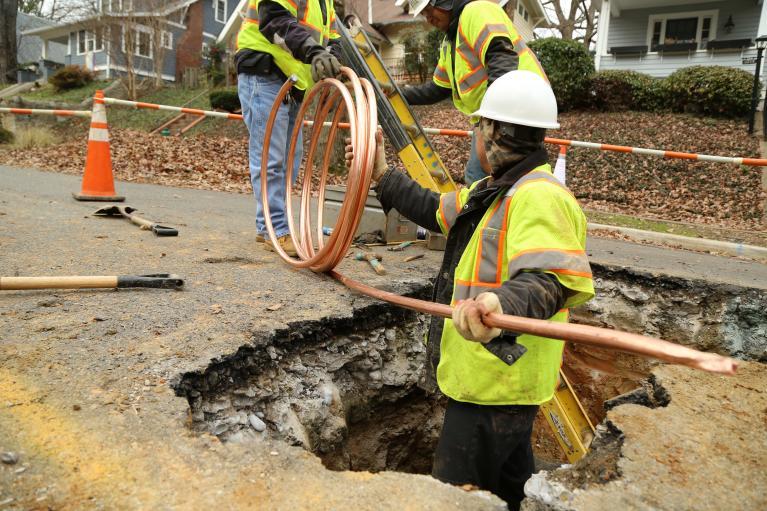
DC Water CEO David L. Gadis today encouraged every District resident to check if the pipe connecting their home to the city water supply is lead, and if it is made of lead to learn more about new opportunities for replacing it with safer copper pipe.
The push to replace lead service lines comes as historic legislation approved by the Mayor and D.C. Council last year goes into effect beginning today. It provides free or discounted plumbing services to District residents who replace lead pipes and should dramatically increase the pace of lead service replacements.
Every property owner regardless of income can now replace their lead pipes for free when DC Water conducts water main replacements or emergency repairs. Residents do not need to apply for this discount, and will be contacted by DC Water in advance of these projects.
Separately, generous assistance is now available for more than ten thousand customers who have lead pipes on private property, but non-lead pipes in public space. In these cases, every property owner can replace their lead pipes at a 50% discount, and some will qualify for 80% or 100% discounts depending on household size and income. Eligibility for these discounts is determined by the DC Department of Energy and Environment and residents can apply for the program at doee.dc.gov.
“No other bill in the last generation has provided such an opportunity to District residents,” said Mr. Gadis. “Everyone who owns a home in the District should know if they have lead pipes, and work with us to get the lead out.
Customers can view a list of known qualifying properties here, or reach out to lead@dcwater.com and 202-787-4044, then visit doee.dc.gov/service/leadlinereplacement or call 311 to apply for discounted replacements.
Under current law, DC Water is permitted to replace the portion of the lead water service line that lays buried within public space but not the portion that is on private property – the pipe that runs from the property line to the building. Water mains in DC Water’s distribution system are not made of lead. However there remain roughly 70 miles of lead service lines spread across the District, mostly in older neighborhoods. Larger apartment buildings and condo buildings typically do not have lead service lines due to the larger size of pipe required to supply water.
Gadis noted that he wants all lead service lines in the city replaced within the next 10 years: “It’s ambitious but it’s achievable if we roll up our sleeves and work together,” Mr. Gadis said.
In addition to establishing assistance programs to help residents remove lead pipes, the new law requires landlords and home sellers to disclose the existence of lead pipes on residential properties, and the results of any past lead testing.
The law originated with Ward 1 Councilmember Brianne Nadeau, who last year introduced legislation to help DC Water customers afford the cost of their lead service replacements. The Bill was then revised by Council Transportation & Environment Committee Chairperson Mary Cheh of Ward 3 and approved unanimously.
More information about the issue of lead, tips to reduce risk of lead exposure, and information about the law can be found at dcwater.com/lead.
###