DC Water Releases Lead Free DC Plan Update and New Lead Inventory Map
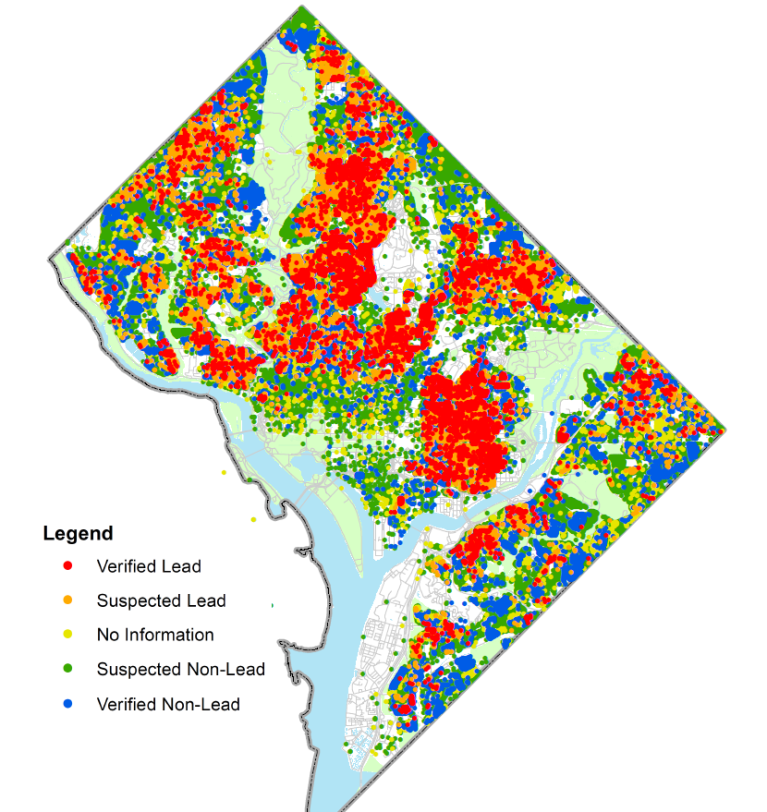
Today, DC Water released its 2023 Lead Free DC (LFDC) Plan, which details the necessary actions required from DC Water, customers, the District of Columbia, and other key partners to accelerate lead line replacement efforts. Lead Free DC launched in 2019 with the ambitious goal of removing all lead service lines in the District by 2030.
“Since 2019 DC Water and our partners have been making significant strides to reduce the sources of lead in drinking water,” said DC Water Chief Executive Officer and General Manager David L. Gadis. “As of May 2023, we replaced more than 4,200 lead service lines with copper pipes. We have leveraged District funding to provide free and discounted replacement programs that saved approximately $7 million for customers.”
DC Water also released more user-friendly customer tools on the LFDC program website. The improved Lead Map allows customers to enter their property address to find out if they have a lead service line. In addition, an updated Construction Dashboard allows customers to see if free replacements for their area are scheduled, in progress or complete. The dashboard will also help homeowners understand which free or discounted lead service line replacement program they are eligible for.
The 2023 Plan includes an updated cost estimate of $1.51 billion, the discussion of a potential legislative mandate requiring all District homeowners to replace their lead pipes, and the additional funding required to avoid adding a financial burden on ratepayers. Acquiring this funding could mean free or discounted lead service line replacements for every resident.
Mr. Gadis added, “The mission of Lead Free DC is to equitably replace all lead service lines to benefit present and future generations. We cannot do this without the cooperation of our community partners, contractors, legislators, and most importantly, our customers. While we work toward removing all lead pipes in the District, we want customers to experience superior service that advances the health and well-being of our diverse communities. We thank all our partners for joining this critical mission.”
Through this plan, DC Water is also recommending a host of policies, permitting, outreach, and funding initiatives necessary to accomplish the lead service line replacement goal by the end of the decade.
To read the updated Lead Free DC plan, and use the updated Lead Map and Construction Dashboard, please visit dcwater.com/lead.
Lead Free DC (LFDC) 2023 Plan Highlights
Progress to date: As of May 2023, the program has replaced 4,287 lead service lines and saved customers $7 million by providing free and discounted replacement programs.
Prioritizing Environmental Justice and vulnerable populations: The LFDC construction program aligns with the Biden-Harris Administration’s Justice40 Initiative. It includes a model to prioritize lead line replacements in areas that have vulnerable populations, a high number of lead service lines, and are historically underserved.
Expanding the Lead Free DC outreach team: In May 2023, DC Water announced the launch of the Community Activators Program, a workforce development training program with the District’s Department of Employment Services (DOES) Division of State Initiatives. The program’s 20 paid trainees from across the District support the LFDC program by informing and educating customers about the program to increase homeowner participation.
Improving the water service line inventory: LFDC scrutinized all the data sources used to develop the inventory. This review led to new classifications for all service lines in the District as verified lead service lines, suspected lead service lines, no information (service lines where there is not a record of the pipe material), suspected non-lead service lines, and verified non-lead service lines. This updated inventory classification system provides DC Water a higher level of confidence when estimating the remaining lead service lines in the District.
New tools to help homeowners : The report announcement included a demonstration of tools to help our customers navigate the water service line inventory to find out if they have a lead service line, and to follow the construction schedule for Lead Free DC.
o Updated inventory map: https://geo.dcwater.com/Lead/
o Updated construction dashboard: https://www.dcwater.com/lead-free-dc-construction-dashboard
Changes to the service line inventory classifications have also led to higher estimates for replacements: Reclassifying the service lines according to high or low confidence in data sources allows DC Water to more accurately estimate the service lines that need to be verified, and how many of those will turn out to be lead even if the inventory record indicates otherwise. As a result, DC Water now estimates replacing 41, 157 lead service lines through Lead Free DC.
The plan also updates the factors informing projected costs: The program’s planning costs are now estimated to be $1.51 billion over the program’s lifecycle. This estimate accounts for replacing a higher number of lead service lines as well as LFDC’s efforts to verify service lines. Other estimate factors are reassessed construction and restoration costs based on trends of the last few years, including inflation.