DC Water Breaks Ground on $2.6 Billion Clean Rivers Project -- Largest Construction Project in DC Since Building of Metro
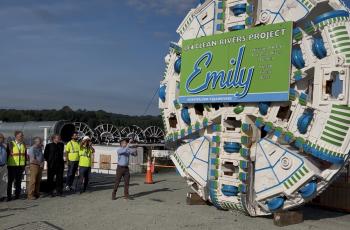
WASHINGTON, DC The District of Columbia Water and Sewer Authority (DC Water) broke ground today on its largest construction project ever, and the Districts largest since Metro was built. The $2.6 billion Clean Rivers Project aims to nearly eliminate combined sewer overflows to the Anacostia and Potomac rivers and Rock Creek, also improving the health of the Chesapeake Bay.
As in many older cities, about one-third of the District has a combined sewer system. A combined sewer overflow (or CSO) occurs during heavy rain when the mixture of sewage and stormwater cannot fit in the sewer pipes and overflows to the nearest water body. CSOs direct about 2.5 billion gallons of combined sewage into the Anacostia and Potomac rivers and Rock Creek in an average year. CSOs contain bacteria and trash that can be harmful to the environment.
DC Water has already reduced CSOs to the Anacostia River by 40 percent with improvements to the existing sewer system. The Clean Rivers Project consists of massive underground tunnels to store the combined sewage during rain events, releasing it to the Blue Plains Advanced Wastewater Treatment Plant after the storms subside. Similar CSO tunnels exist in Chicago, Indianapolis, Atlanta and other cities.
There can be no overestimating the scale of this project its absolutely huge, said DC Water General Manager George S. Hawkins. The machine our teams will use to build these tunnels is the size of a football field, and needs to be assembled in pieces underground. And because of this work, no single institution is doing more than ours to improve the Districts waterways.
The first tunnel system, and the largest, will serve the Anacostia River. The first part of that system, named the Blue Plains Tunnel, is 23 feet in diameter and runs more than 100 feet deep. It will extend from Blue Plains in Southwest DC, roughly along the east bank of the Potomac, crossing under the Anacostia and extending along the west bank to about RFK Stadium.
From there, it extends north and west to form a segment known as the Northeast Boundary Tunnel. The tunnel segments south of RFK Stadium, together with their surface hydraulic facilities and a tunnel dewatering pump station, are scheduled to be put into operation by March 2018, providing relief to the Anacostia first. The remainder of the tunnel north of RFK Stadium is required to be completed by 2025.
Since the early 1900s, only sewer systems with separate pipes for sewage and stormwater have been installed in the District.
The Clean Rivers Project is the result of a 2005 federal consent decree. DC Water is beginning discussions with the parties on reopening the agreement. The goal would be to explore green-development technologies that could reduce or eliminate future pieces of the project, create jobs, green the District and reduce rate increases for customers. Other cities, notably Philadelphia, have proposed CSO solutions that rely heavily on green techniques instead of tunnels.
We are looking at other ways to manage combined sewage in the Rock Creek and Potomac River sections, Hawkins added. No city or utility has ever done a sustained and large-scale pilot study of green roofs, trees and porous pavement to help in those areas. We hope to do just that.
Contact:
Pamela Mooring
Communications Manager
(202) 787-2089
Pamela.Mooring@dcwater.com
Alan Heymann, Esq.
Chief, External Affairs
(202) 787-2616
Alan.Heymann@dcwater.com